
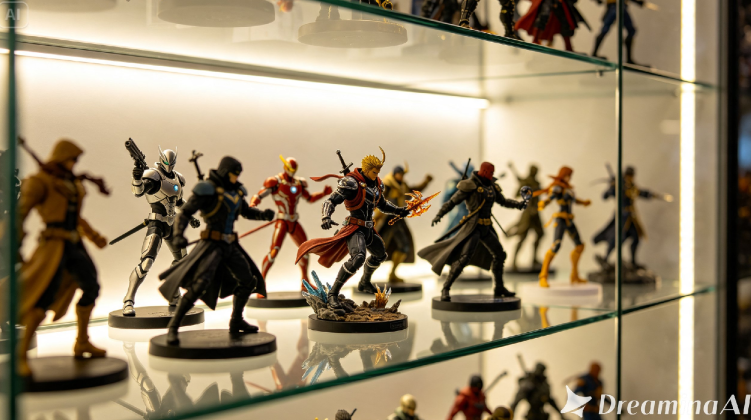
Collectors tend to know something the rest of the world doesn’t always appreciate: a display case isn’t just storage; it’s a small, curated exhibition. A photo of that display captures the arrangement, but it rarely captures what makes standing in front of it actually satisfying — the way light catches a rare figure’s paint job, the sense of scale when dozens of pieces sit together.
With image to video technology, that display can finally be shown the way a collector actually experiences it. Dreamina, powered by its latest and most advanced video generation model, Seedance 2.5, lets collectible owners turn a flat photo of their display into a genuine showcase.
A display case was built to be walked past slowly
Anyone who has arranged a collection knows the placement isn’t random — favorite pieces get better lighting, rarer items get more space, a sequence often tells a small story of how the collection grew. A static photo flattens all of that intention into one frame. Motion restores the sense of pacing a collector actually intended when building the display in the first place.
Matching camera movement to the type of collectible
Delicate, high-value items like rare cards or fine models benefit from slow, careful camera movement that treats each piece with visible respect, while bolder collectibles like action figures or toys can support a slightly more energetic pace. Naming that tone in your prompt helps Seedance 2.5 shape the pacing to match the collection’s actual character.
Telling the story behind specific pieces
A showcase video doesn’t need to rely purely on visuals. Adding a short voiceover or on-screen text about how a particular piece was acquired, or what makes it rare, turns a simple visual reveal into content that resonates more with fellow collectors and curious viewers alike.
Documenting condition and authenticity through detail
For higher-value collectibles, a slow, detailed showcase can double as a visual record of a piece’s condition at a given point in time, useful for insurance purposes, resale listings, or simply keeping a personal record of a collection as it grows and changes over the years.
Filming your display without a camera: three steps with Dreamina
Step 1: Upload reference image and write corresponding prompt
Visit Dreamina and sign in, then head to the “AI Video” section. Click “Add reference image” to upload your photo, then add your prompt to describe the video.
For a 30-second video, try: Using the display case and figures from the reference image, generate a 30-second showcase video: camera slowly gliding across the shelves from left to right, soft accent lighting highlighting paint detail on each figure, subtle reflections shifting on the glass case, camera pausing briefly on the rarest figure before pulling back in the final seconds.
Step 2: Generate your video
After adding your image and prompt, choose the Seedance 2.5 model for the generation. Next, choose the video length, then a suitable aspect ratio — pick 16:9 for YouTube or 9:16 for TikTok. Finally, click Dreamina’s icon and wait a few seconds for processing.
Step 3: Enhance & export the video
Polish your video before saving it with Dreamina’s AI editing tools. Use advanced AI tools like Upscale for higher resolution or Generate soundtrack for adding audio. Finally, export and share it on social media platforms.
Deciding how much of the collection to show at once
A full display case might hold dozens of items, but a single video works better focused on one shelf or one themed grouping rather than trying to capture an entire collection in one sweep. Smaller, focused sequences tend to hold viewer attention far better than one overwhelming wide shot.
What Seedance 2.5 brings to detailed collectible content
- A significantly reduced “AI look,” giving painted figures, cards, or models a more physically believable material and light response
- Reading complex spatial layouts through richer references, including white model data, useful for shelves with items arranged at different depths
- Native clips up to 30 seconds, with an “Ultra-long Video Generation (beta)” mode reaching up to 180 seconds for a fuller shelf-by-shelf walkthrough
- Precise local editing, allowing a stray reflection or dust speck on the display glass to be corrected without regenerating the entire scene
What a showcase video reveals that a photo can’t
- The relative scale and arrangement of pieces sitting side by side
- Fine paint, material, or craftsmanship detail on individual items
- A sense of the collection as a curated whole, not just a list of objects
Handling reflective glass and case surfaces carefully
Display cases often involve glass or acrylic surfaces that can introduce unwanted glare or reflection in a generated scene. Describing the case material directly in the prompt, and relying on local editing afterward for any stray reflections, tends to produce a cleaner final result than leaving that detail unaddressed.
Sharing showcases within collector communities
Collector communities, whether built around sneakers, cards, action figures, or memorabilia, tend to engage far more with moving showcase content than static photo posts, since motion better conveys the detail and care that collectors themselves value most.
Where these collectible showcase videos perform best
This format works especially well for hobbyist social communities, resale and marketplace listings, personal collection blogs, and convention or meetup promotion, where a moving reveal often earns far more genuine engagement than another flat photo of a shelf.
Growing a showcase library over time
Rather than treating this as a one-time project, many collectors find it useful to animate new pieces as they’re added to a display, gradually building a growing library of showcase clips that tracks how a collection has expanded, one addition at a time.
Final thought
A collection was never meant to be appreciated as a flat photo — it was built piece by piece to be seen the way a collector actually sees it. With Dreamina and the detail-driven realism behind Seedance 2.5, a display case can finally be shown the way it was always meant to be admired.