
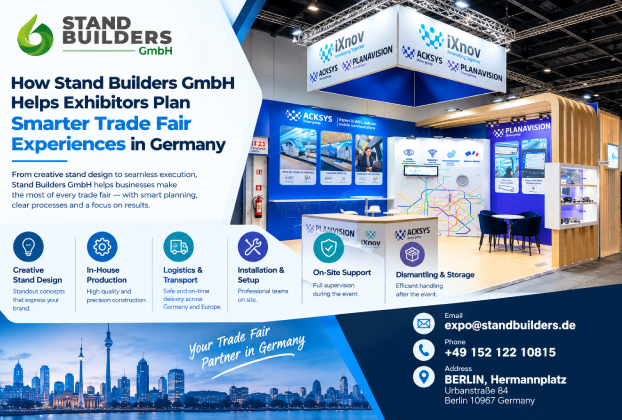
Participating in a German trade fair offers businesses an opportunity to introduce products, connect with industry professionals, and explore new markets. However, achieving meaningful results requires more than booking exhibition space and displaying promotional materials. Choosing an experienced exhibition booth builder in Germany helps companies coordinate stand design, technical requirements, construction, and event preparation. Stand Builders GmbH, based in Berlin, provides integrated exhibition solutions that support businesses exhibiting in major German trade fair destinations, including Essen.
The Hidden Challenges Behind a Successful Trade Fair Appearance
Trade fairs bring together companies competing for the attention of visitors who often have limited time and specific business interests. Exhibitors must communicate their value quickly while providing enough information to encourage meaningful conversations.
This creates several practical challenges. The stand needs to reflect the brand, accommodate products, provide suitable meeting areas, and remain accessible throughout the event. At the same time, construction must comply with venue regulations and fit within a fixed installation schedule.
Businesses sometimes concentrate heavily on appearance while overlooking operational details. A visually impressive booth may become ineffective if demonstrations block visitor movement or staff have insufficient space for consultations.
Successful exhibition planning therefore requires a balance between presentation, functionality, and technical execution.
Designing Around the Visitor’s Decision-Making Journey
An exhibition stand should guide visitors naturally from initial curiosity to meaningful engagement. Rather than filling every available surface with graphics, exhibitors should consider how people discover, enter, and interact with the space.
Creating Visibility Without Visual Overload
Clear brand identification helps visitors recognise a company from the exhibition aisle. Well-positioned signage, coordinated colours, and concise messaging can communicate the exhibitor’s purpose without overwhelming the audience.
Lighting also influences how visitors perceive products and displays. Focused lighting can highlight important features, while balanced general illumination makes the stand comfortable for conversations.
An effective design does not require excessive decoration. Often, carefully selected visual elements create a stronger impression than crowded graphics.
Making Space for Product Demonstrations
Product demonstrations are particularly important for technology, engineering, manufacturing, and industrial exhibitors.
Demonstration zones should provide sufficient room for equipment, presenters, and interested visitors. Screens and interactive displays need to be positioned where audiences can view them comfortably.
When demonstrations involve sound, movement, or specialised equipment, the surrounding layout should minimise disruption to nearby meetings.
Supporting Conversations That Lead to Business Opportunities
Trade fair participation frequently involves conversations with distributors, buyers, suppliers, and potential partners.
A dedicated meeting area can help staff discuss technical requirements, pricing, and partnership opportunities without unnecessary distractions.
Depending on the exhibition’s objectives, this space may include informal seating, consultation counters, or enclosed meeting rooms.
Why Essen Deserves Attention in German Exhibition Planning
Essen is an established exhibition destination in Germany’s Ruhr region, with events serving industries such as energy, security, industrial technology, and specialist consumer markets.
Messe Essen provides an environment where businesses can present innovations, meet industry representatives, and develop commercial relationships. Exhibitors attending events in the city should consider the audience profile, exhibition hall arrangements, and technical requirements before deciding on a stand concept.
For companies preparing to exhibit locally, working with an exhibition stand design company in Essen can help connect creative planning with the practical requirements of the venue.
Stand Builders GmbH provides exhibition design and construction services for Essen alongside its wider operations across Germany and Europe.
Matching the Stand to the Industry
An energy-sector exhibition may require detailed technical presentations, equipment models, and spaces for discussions with commercial buyers.
A consumer-oriented event may benefit from accessible product displays, live demonstrations, and more open visitor circulation.
The city alone does not determine the appropriate design. The exhibition’s purpose, target audience, and product characteristics should guide the final layout.
Preparing for Venue-Specific Requirements
Every exhibition venue has operational conditions that influence construction and installation.
Exhibitors should confirm stand height restrictions, permitted materials, electrical arrangements, delivery schedules, and approval procedures before finalising their design.
Early coordination reduces the likelihood of expensive modifications during the final preparation stages.
Choosing an Exhibition Stand Format That Supports Business Goals
Not every company requires the same type of exhibition structure. The most suitable solution depends on the available floor area, frequency of participation, branding requirements, and intended visitor activities.
Stand Builders GmbH provides four principal exhibition stand solutions, each suited to different presentation needs.
Custom exhibition stands offer greater freedom in architectural design, branding, and product presentation. They are useful for companies requiring distinctive structures or specialised demonstration spaces.
Modular exhibition stands use adaptable components that can be reconfigured for different events. Their flexibility makes them particularly relevant for businesses participating in multiple trade fairs.
Double-decker exhibition stands provide an additional level that can accommodate meetings, hospitality functions, or private discussions. Their construction requires appropriate engineering and venue approval.
Country pavilion exhibition stands bring multiple exhibitors together under a coordinated national or regional presentation. They allow participating organisations to maintain individual identities within a unified exhibition environment.
Selecting the right format early helps businesses allocate their budgets more effectively and avoid unnecessary design complications.
From Technical Drawings to the Exhibition Hall
An exhibition stand becomes a reliable business environment only when the design can be translated into a practical structure.
Stand Builders GmbH follows a coordinated process covering briefing, three-dimensional design, production, packaging, delivery, installation, and dismantling. The company also offers on-site supervision and storage support.
Its in-house production facilities help connect the design and manufacturing stages, allowing construction requirements to be considered during project development.
Reviewing the Design Before Production
Three-dimensional concepts help exhibitors understand how their finished stand will look and function.
They provide an opportunity to assess entrance positions, furniture arrangements, branding visibility, and product placement before manufacturing begins.
Client feedback at this stage is particularly valuable because changes made before production are generally easier to manage than modifications requested during installation.
Coordinating Delivery and Installation
Exhibition halls operate according to defined access and setup schedules. Components must arrive on time, be assembled correctly, and undergo appropriate checks before the event opens.
Effective coordination between production, transportation, and installation teams reduces avoidable delays.
After the exhibition, dismantling and storage arrangements are also important, particularly for businesses planning to reuse structural components.
Making Exhibition Investments More Practical
A successful trade fair strategy considers both immediate presentation requirements and long-term participation plans.
Companies exhibiting several times a year should evaluate whether stand elements can be reused or adapted. Modular components, durable furniture, and replaceable graphics may help reduce repeated production requirements.
Businesses should also distinguish between essential features and optional enhancements. Clear branding, functional meeting areas, and appropriate lighting usually deserve priority over decorative elements that provide limited practical value.
Budget planning should account for more than stand construction. Transportation, technical connections, installation, dismantling, and storage may all contribute to the total exhibition cost.
A detailed project brief and transparent quotation process can help exhibitors make better-informed decisions.
Evaluating Results After the Exhibition
The exhibition stand is only one part of the overall marketing investment. Its performance should be evaluated against the objectives established before the event.
Companies can review the number of qualified leads, product demonstrations, scheduled meetings, and follow-up opportunities generated during participation.
Visitor feedback can also reveal whether the layout supported effective communication. If visitors struggled to locate a demonstration area or meeting spaces became overcrowded, those observations should influence future designs.
By combining commercial results with operational feedback, businesses can make each subsequent exhibition more efficient.
Conclusion
An effective trade fair presence requires a coordinated approach that connects business objectives with visitor experience, stand design, construction, and event logistics. For exhibitors attending events in Essen and other German cities, early planning and attention to venue requirements can make a significant difference.
Stand Builders GmbH supports this process through custom, modular, double-decker, and country pavilion solutions, alongside design, production, installation, and dismantling services.
Ultimately, a well-planned exhibition stand should do more than create a strong first impression. It should provide a functional environment where businesses can explain their value, build professional relationships, and turn exhibition participation into meaningful commercial opportunities.